Environment & Immune-mediated diseases: Exposomic insights from the HEDIMED Project
On Tuesday, 22nd May, the HEDIMED team hosted the projet’s final public event — a culmination of years of groundbreaking work exploring how environmental exposures influence immune-mediated diseases. The online event “Environment & Immune-mediated diseases: Exposomic insights from the HEDIMED Project – Final Stakeholder Event” brought together over 100 participants from 17 different European countries! Attendees came from varied backgrounds, and united by a shared interest in the exposome and its growing role in public health.
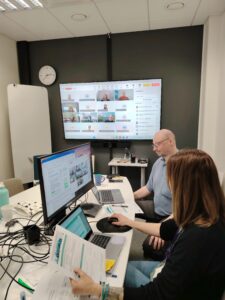
Picture: Olli Laitinen and Jutta Laiho at home studio at Tampere University
The event opened with introduction of the project by HEDIMED Tampere University team, scientific manager Jutta Laiho and project coordinator Heikki Hyöty:
Straight after, a forward-looking perspective was given as Irini Kessissoglou from the European Commission’s DG SANTE introduced the European Health Data Space (EHDS). She outlined how the EHDS aims to streamline the secondary use of health data for research, innovation, and policymaking. By creating a federated infrastructure that protects individual privacy while enabling access for the public good, EHDS represents a major shift. Most notably, from 2029 onwards, reuse of health data will not require individual consent:
As the discussion transitioned from policy to science, attendees were immersed in the project’s key research findings. Aki Sinkkonen from the Natural Resources Institute Finland highlighted how exposure to biodiverse environments can support immune system regulation. His team’s intervention trials, including “rewilded” daycare yards, showed promising improvements in children’s immune markers. Long-term studies are still underway, but early results are encouraging:
After this, Heikki Hyöty took us deeper into the microbial world, sharing findings that link specific viruses, such as enteroviruses and parechoviruses, to an increased risk of celiac disease and type 1 diabetes. His work revealed that even prenatal infections and inflammation might set the stage for immune-mediated diseases later in life. Using multi-omics apporach like virome, metabolome, and transcriptome analyses, the research aims to unravel the complex biological mechanisms behind these associations:
Chemical exposures were another major focus. Panu Rantakokko from the Finnish Institute for Health and Welfare (THL) described how immune-disrupting chemicals, PFASs, have seen declining exposure levels thanks to stricter regulations. However, legacy exposure remains an ongoing concern. While no strong link has yet been found between PFAS and immune-mediated diseases in current cohorts, the investigation continues:
From a broader lens, Ketil Størdal from the Norwegian Institute of Public Health presented evidence that multiple immune-mediated diseases often co-occur due to shared genetic and environmental risk factors. Patterns of higher disease incidence in northern regions support this theory. On the other hand, green space access and microbiome diversity emerge as potentially protective factors:
The event also showcased the cutting-edge tools and technologies developed within HEDIMED. Loïc Burr and Silvia Demuru from CSEM showcased a low-cost, portable biosensor capable of detecting allergens through fluorescence. The device holds promise for point-of-care diagnostics, expanding access to testing in real-world settings:
Petri Saviranta from VTT (Technical Research Center of Finland) introduced a high-throughput multiplex assay capable of detecting antibodies to over 40 microbes from tiny blood samples: an innovation that could revolutionize large-scale exposomic screening. Satellite data was also used to map environmental characteristics around children’s homes, giving researchers a clearer view of early-life exposures:
In addition, Juha Pajula (VTT Technical Research Center of Finland) and Apostolia Karabatea (Gnomon) unveiled new data platforms designed to make exposomic analysis both secure and user-friendly. These tools support interactive dashboards that let stakeholders explore findings directly, laying the groundwork for future integration with EHDS:
Prevention was a major thread throughout the event. Jani Mäkinen from Tampere University presented a cost-effectiveness model comparing strategies for childhood celiac disease screening. His findings suggest that a single antibody screening at age 11 is the most cost-effective, though combining earlier and later screenings with HLA genotyping also yielded strong outcomes:
Finally, Heikki Hyöty returned to present modeling results for preventive interventions against type 1 diabetes, work based on VTT’s input. The work showed that combining primary prevention (such as enterovirus vaccination) with secondary prevention (like immunomodulatory treatments) could significantly reduce disease incidence:
An interactive highlight of the event took place at the end of the day: A lively panel discussion brought additional societal depth into the exposomic topics. Experts including Gabriele Berg (Graz University of Technology), Juha Pajula (VTT Technical Research Center of Finland), Kalle Kurppa (Tampere University), Hanna Haveri (Päijät-Häme Wellbeing County), Tiina Vitikainen (Finnish Allergy, Skin and Asthma Federation), and Helka-Liisa Hentilä (Oulu University) discussed how exposomic findings could be translated into policy and practice.
The conversation emphasized the importance of strong data infrastructures, new technologies, citizen engagement, and above all, continuous communication across sectors:
The event concluded with a clear and forward-looking vision: exposomic insights must be woven into public health strategies, particularly in urban planning, early childhood development, and disease prevention. Prioritizing access to biodiverse green spaces—especially for children vulnerable to immune-mediated diseases—emerged as a critical step. Preventive care should increasingly account for environmental exposures, with nature contact and dietary diversity recognized as practical, evidence-based measures.
Looking ahead, the European Health Data Space (EHDS) offers new possibilities for integrating exposomic data into health surveillance and planning. Advancing the field will depend on expanding cohort studies and developing models that connect environmental, clinical, and molecular data: laying the groundwork for more precise, preventive, and personalized public health. The message was clear: to build healthier futures, we must understand not only our genes and microbes, but the environments that shape them both.
The HEDIMED Project may be drawing to a close, but its legacy lives on. Thank you everyone for attending!